Can NLP Detect Lies? The Future of Truth Verification
28 June 2026
We have all been there. You are listening to a politician give a slick speech, a friend tells a "harmless" white lie, or you are reading a product review that sounds too good to be true. That little voice in your head asks: Are they lying? For centuries, we have relied on gut feelings, body language, and expensive polygraph machines. But what if a computer could do it better? What if the words themselves, analyzed by a machine, could reveal deception?
That is the promise of Natural Language Processing (NLP) in lie detection. It is not science fiction anymore. It is a rapidly evolving field that is turning truth verification on its head. But can NLP really detect lies? Or are we just building a more sophisticated version of a magic trick? Let's dig into the code, the psychology, and the messy reality of using AI to spot a fib.
The Old Way vs. The New Way: From Sweat to Syntax
Before we get into the algorithms, let's look at what we are replacing. Traditional lie detection, like the polygraph, is a biomechanical approach. It measures heart rate, blood pressure, breathing, and skin conductivity. The idea is that lying makes you nervous, and nerves cause measurable physical changes. Sounds logical, right? The problem is that it is deeply flawed. A calm sociopath can beat it. An anxious innocent person can fail it. The polygraph is not really detecting lies; it is detecting stress.NLP takes a completely different angle. It does not care about your sweat glands. It cares about your word choices. Think of it this way: a polygraph listens to your body's drumbeat. NLP listens to the lyrics of your story. It is a shift from physiology to linguistics.
NLP models are trained on massive datasets of known truths and known lies. They learn patterns we humans often miss. For example, liars might use fewer first-person pronouns ("I," "me," "my") to psychologically distance themselves from the falsehood. They might use more negative emotion words ("hate," "angry," "terrible") or more exclusionary words ("but," "except," "without") to hedge their statements. They might even be overly detailed, because they rehearsed the story, or suspiciously vague, because they are making it up on the spot.
This is where the magic happens. Instead of asking, "Is your heart racing?" we ask, "Is your language shifting?" And that is a question a computer can answer at scale, in real time, and without a person in the room.

How NLP Actually "Reads" Between the Lines
So, how does this work under the hood? It is not one single trick. It is a cocktail of techniques. Let me walk you through the main ingredients.Linguistic Inquiry and Word Count (LIWC) is one of the oldest and most transparent methods. It is a dictionary-based approach. You feed a text into it, and it counts how many words fall into categories like "certainty," "tentative," "positive emotion," and "cognitive processing." Research using LIWC has shown that liars tend to use fewer cognitive processing words (like "think," "know," "understand") because they are not actually working through a real memory. They are repeating a script.
Then you have Stylometry. This is the analysis of writing style. It looks at sentence length, word frequency, and even punctuation habits. A person who usually writes long, complex sentences might suddenly write short, choppy ones when lying. Or they might start using more formal language. Your personal "linguistic fingerprint" changes when you step outside the truth.
The real heavy lifting today comes from Deep Learning models, specifically Recurrent Neural Networks (RNNs) and Transformers (like BERT). These models do not just count words. They understand context. They look at the entire sequence of words and learn the subtle relationships between them. For example, a Transformer can spot that a sentence like "I did not take the money" is much more likely to be a lie if the surrounding text is full of justifications and deflections. These models can detect "semantic inconsistency" - when the meaning of a sentence clashes with the meaning of the paragraph around it. It is like hearing a wrong note in a song. The music sounds fine, but your ear knows something is off.

The Real-World Tests: Where NLP is Already Working
You might be thinking, "This sounds great in a lab, but does it work in the real world?" The answer is a cautious yes, in specific, controlled environments.Airport Security is a fascinating test case. Researchers have run experiments where participants either told the truth about a trip or lied about a cover story. NLP models, analyzing transcripts of their interviews, could detect deception with accuracy rates above 80% in some studies. They picked up on cues like "um" hesitation, increased use of "uh," and shorter, less detailed responses. The machine could spot a liar faster than a trained human interrogator.
Online Fraud Detection is another hot area. Banks and insurance companies are using NLP to analyze claim descriptions. A fraudulent claim for a stolen laptop might use overly dramatic language, or it might lack specific, verifiable details. The algorithm flags it for manual review. It is not a conviction, but it is a powerful triage tool.
Political Fact-Checking is a trickier but promising application. Tools like "ClaimBuster" and "FactStream" use NLP to identify factual claims in real-time during debates and speeches. They then compare those claims against a database of verified facts. They cannot detect a "lie" in the moral sense - they cannot know if the politician believes the falsehood. But they can detect a statement that contradicts known reality. It is truth verification, but it is truth against a database, not truth against intention.

The Elephant in the Room: Why It Is Not Magic
Alright, let's pump the brakes. I have painted a picture of a futuristic truth machine. But the reality is far messier. NLP lie detection has some serious, fundamental limitations.The Training Data Problem. To teach a model to detect lies, you need a huge dataset of verified lies. How do you get that? You cannot just ask people to lie in a lab. Lab lies are low-stakes. They are "I lied about eating the cookie" lies. Real-world lies are high-stakes: "I did not commit the crime," "I did not steal the money," "I love you." A model trained on cookie lies will fail miserably on court testimony. The emotional weight, the consequences, the rehearsal - it is all different.
Cultural and Linguistic Bias. Language is not universal. An NLP model trained on American English might flag a Japanese speaker's indirect communication style as deceptive. A model trained on text-based lies might fail on spoken lies, where tone and pace matter. We risk building a system that punishes people for speaking differently, not for lying.
The Deceiver's Advantage. Liars adapt. If a model learns that liars avoid using "I," a clever liar will start using "I" constantly. "I, John Smith, hereby state that I did not take the money." It becomes a cat-and-mouse game. The model is always playing catch-up to the latest deception tactic. And unlike a human interrogator, the model cannot ask a follow-up question to catch you off guard.
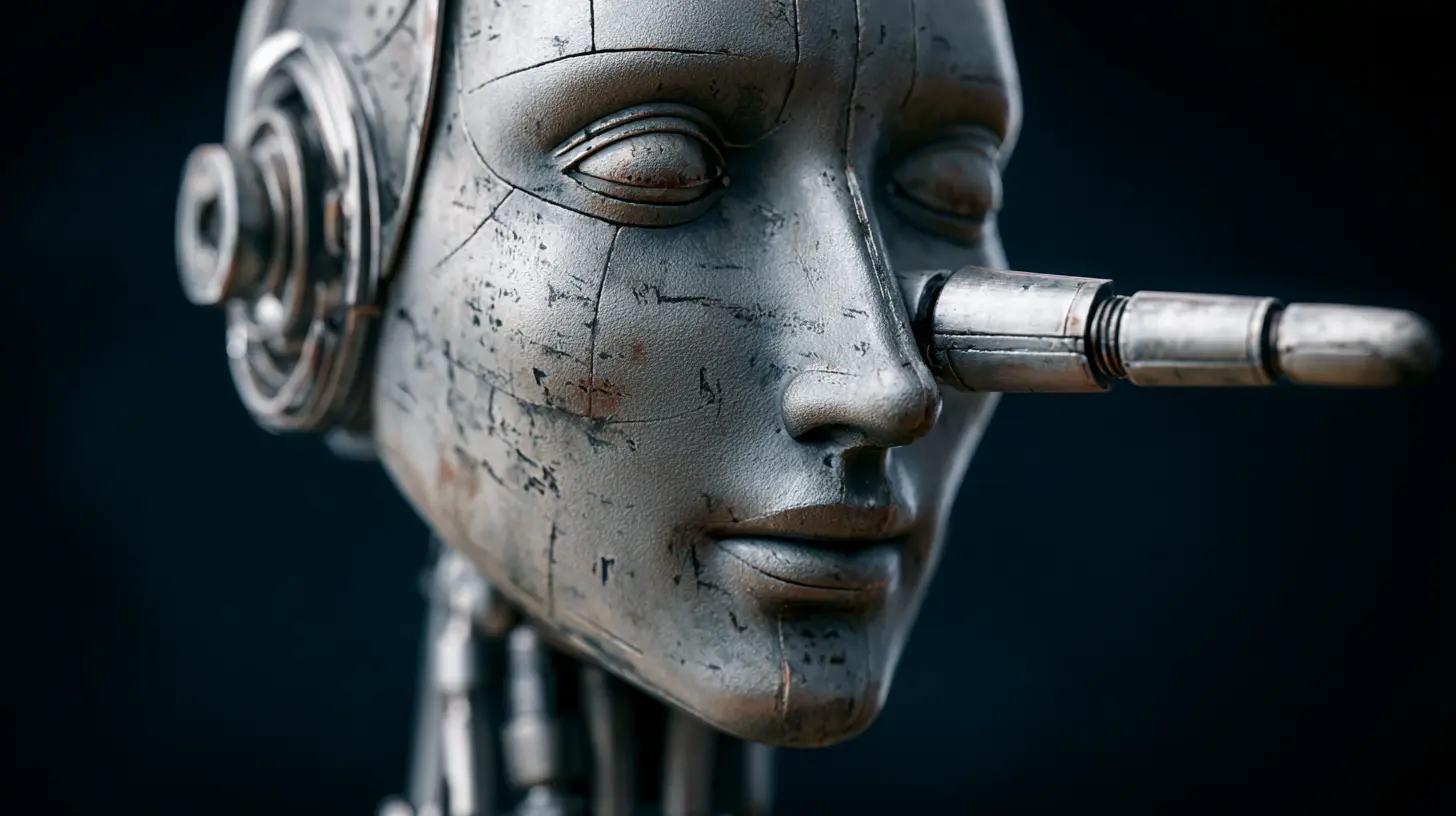
The Pinocchio Problem. Here is the biggest one. NLP detects patterns in language. It does not detect intent. A person with a traumatic memory might tell their story with hesitation, contradictions, and emotional distance. The model flags it as a lie. But it is the truth. A pathological liar might tell a lie so smooth and confident that the model approves it as truth. We are measuring the shape of the story, not the truth of the story. That is a critical distinction.
The Future: A Tool, Not a Judge
So, where does this leave us? Is NLP lie detection a dead end? Not at all. But we need to stop thinking of it as a "lie detector" and start thinking of it as a "truth assistant."The future is not a machine that points at you and screams "LIAR!" The future is a machine that says, "Hey, this statement has some unusual patterns. You might want to ask a few more questions." It is a risk scoring system, not a verdict.
Imagine a courtroom where the judge gets a real-time linguistic analysis of a witness's testimony. It does not replace the jury. It gives them a second opinion. "This witness is using a lot of distancing language. Their story is highly consistent, but lacks specific sensory details." The jury can use that to guide their own critical thinking.
In journalism, NLP could be a first-pass filter for press releases and anonymous tips. It flags the ones that look suspicious. The reporter then digs deeper.
In your own life, imagine a browser extension that analyzes the language of a news article or a product review. It does not tell you it is a lie. It tells you it has "low certainty markers" or "high emotional manipulation language." It gives you a nudge to be skeptical.
That is the real power. Not a truth machine, but a skepticism amplifier.
The Ethical Minefield We Must Navigate
We cannot talk about this technology without talking about the ethical risks. They are enormous.Privacy. Do you want your text messages, emails, and phone calls analyzed for deception? Do you want your boss to run an NLP lie detector on your Slack messages? We are heading toward a world where every word you type could be scored for honesty. That is a chilling thought.
False Positives. A false positive in a lie detection system is not just an error. It is an accusation. If a bank's NLP system flags your insurance claim as deceptive, you might be denied payment. If a border control system flags your visa interview as a lie, you might be denied entry. The stakes are human. And the models are not perfect.
The Automation of Distrust. We are building systems that assume everyone is a liar until proven otherwise. That is a corrosive social dynamic. It erodes trust before it is even earned. We need to be careful that our quest for perfect truth does not create a world of total suspicion.
A Final Thought: The Human Element Still Matters
Here is the bottom line. Can NLP detect lies? Yes, statistically, it can detect patterns associated with deception better than most humans. But can it detect the truth? No. Truth is not just a linguistic pattern. Truth is context. Truth is intention. Truth is a person's lived experience.NLP is a powerful tool. It is like a microscope for language. It can reveal structures and patterns we cannot see with the naked eye. But a microscope does not tell you if the cell is healthy or diseased. It just shows you what is there. You still need a trained pathologist to interpret it.
The future of truth verification is not a machine replacing the human. It is a machine empowering the human. It gives us more data, more angles, more questions. But the final judgment? That still belongs to us. We are the ones who have to decide whether to trust the words, or trust the person behind them.
So, the next time you get that gut feeling that someone is lying, remember: your gut is just a very old, very slow NLP model. And your brain? That is the only truth detector that matters.
all images in this post were generated using AI tools
Category:
Natural Language ProcessingAuthor:

Marcus Gray